
What’s inside the issue?
Click the links for a teaser excerpt of each piece…
Letter from the Editor
Happy new year and welcome to 2026. It’s mid-December as I write this and where I live, in Sacramento, California, it has been a bowl of gray, soupy fog for weeks. We haven’t seen the sun since Thanksgiving. It’s dreary. And, with the sun setting as early as 4:30, it’s just dark.
The weather seems to match the collective mood and emotional state right now. Many people, myself included, are coming to the end of what has felt like a very long, very hard year. Maybe you feel like it’s been that way for the last several years—I know I have.
It feels like we’ve been in the dark.
And, I don’t know about you, but I don’t yet see the light at the end of the tunnel.
That’s not to say there haven’t been moments of joy and laughter, a few sporadic bright spots along the way; it’s just been a while since we’ve seen the sun.
When this happens, one of the most comforting things for me is a good story.
Whether it’s a memoir (audio book for me these days), a feel-good movie that lets me escape for a couple of hours, or a heart-to-heart conversation with a friend, it’s the story that’s like holding a candle while I keep walking, doing my best to find my way in a dark season.
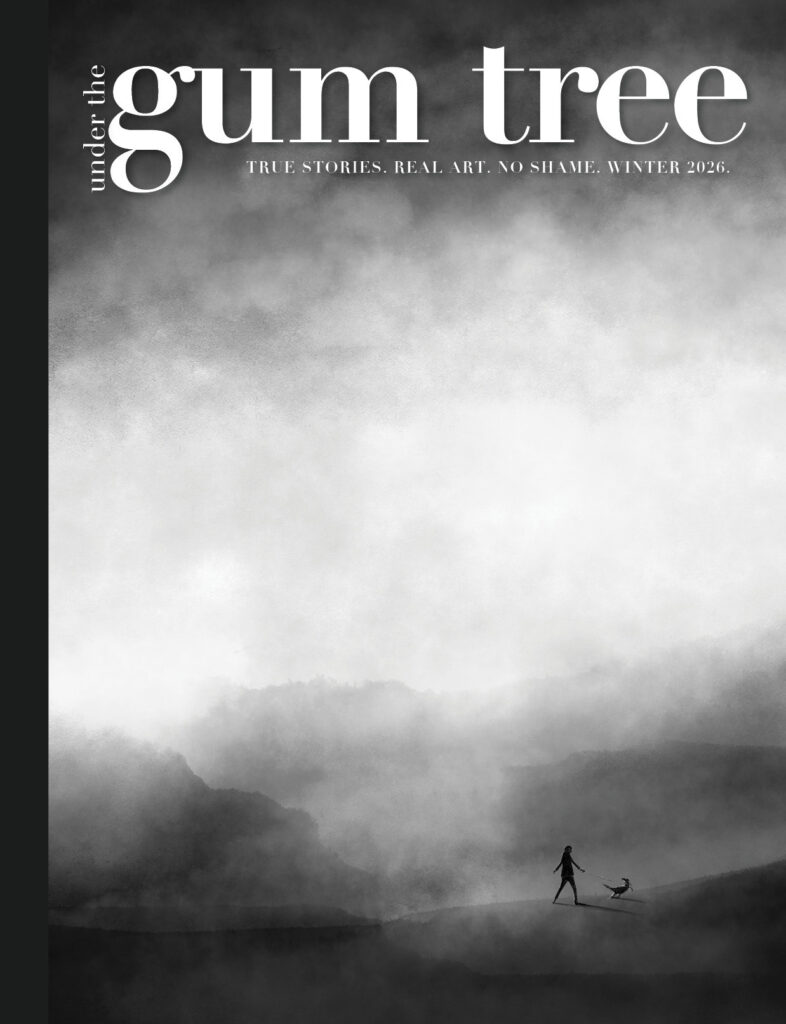
The art in this issue encapsulates this feeling perfectly—darkness all around, consuming nearly everything, a tiny shimmer of light reminding us that all it takes is a single, simple spark to allow us to see exactly what we need to.
So as we begin this new year, let this issue be a book of matches.
Inside are stories that examine the high cost of death row execution, a mother’s burden and pain when her child is sick or injured, the deeply ingrained identity of self-denial, the toll of colonization on an Indigenous community, and the trauma of losing family and friends too soon.
As you read, allow each story to be its own spark, lighting up your world even if only for a moment or two. Sometimes that’s enough to help us see the next step and to reignite a glimmer of hope.
Happy new year, my friend, and here’s to telling stories without shame,

Janna Marlies Maron
Editor & Publisher
Contributing Authors
-
Catherine Berresheim
Lessons from Death RowI have been inside penitentiaries and worked with prisoners before—facilitating creative writing groups and teaching composition classes for over a decade. Still, I was not prepared for Unit Two, death row at Riverbend Maximum Security Institute.
Unlike other facilities where I taught, the complex’s perimeter was surrounded by a twenty-five-foot-tall fence, with lookout towers and armed guards at each of the four corners. On top of the chain-link lattice, three rows of concertina wire, its barbed razor edges swirl in all directions. Prisons have razor wire, even prisons in the middle of Nashville, Tennessee, yet this amount seemed to send a message, “Warning, extremely dangerous people within.” I questioned what I had gotten myself into.
While our belongings were screened on a conveyor belt similar to a TSA scanner, each volunteer stood on a platform that moved like a train car along a half-circle rail taking a full body x-ray image to detect hidden contraband on, or inside, the body.
Then, our group of five Vanderbilt Divinity School volunteers began the fifteen minute walk to Unit Two. We first moved to an outside area known as “No Man’s Land,” because in addition to razor wire, there were two sets of electrified fencing. Our director pushed buttons, metal gates opened and locked behind us with heavy finality.
“Have you ever been on a unit before?” he asked.
“Yes, but not to death row,” I said.
Catherine Berresheim earned her MFA in creative nonfiction from Spalding University’s Naslund-Mann Graduate School of Writing. Recent publications include HuffPost, Manifest Station, and SHIFT. Her essay “Catlike” is featured in Chicken Soup for the Soul: Lessons I Learned from My Cat. In addition, “Cancer: The Great Motivator” is due out in 2026 in the anthology There Are Writing Emergences: Composing Ourselves During Crisis.
-
Hanna Saltzman
Hanna Saltzman
Fault LinesIn the photograph, my baby boy catapults through blue-gray ocean sky. He’s bundled in a purple bodysuit, chubby cheeks spilling out of his fleece hood, mouth flung open with delight. When I took the photo, I stood a few feet from him in the grass, three thousand miles from our desert home, trying to push my thoughts just as far away. Trying not to think about how, before this vacation, I had ducked into a hospital call room, chucked my pager across the room, shoved a pillow over my face, and wailed.
I had been imagining my son’s other mother—the fictional mother he could have had instead of me.
His other mother who held him with one hand and, tucking her perky blonde bob behind an ear, stirred homemade minestrone with the other. The other mother who smelled like chocolate chip cookies, signed up for parent committees and didn’t need a trail of ants to remind her to clean behind the oven. Maybe if I wasn’t here, my exhausted brain whispered as it splintered and jumbled and quaked, then this other mother would give my baby what I can’t.
Hanna Saltzman is a writer, pediatrician, and mother in Salt Lake City. Her essays, flash nonfiction, and poetry appear in River Teeth, The Sun, Terrain.org, Intima, and JAMA, among others, and have received awards including selection for the Best American Essays notable essay list. She thanks Mieke Eerkens and her workshop at the 49 Writers Tutka Bay Writers’ Retreat for the writing prompt and gentle encouragement that led to this piece.
-
Samantha Sorenson
Samantha Sorenson
Marriage in Four MetaphorsWe are galaxies. I see them mapped tight over our skin. I trace the miniscule lines crosshatching his neck, his wrists, the backs of his knees, the soles of his feet—a billion stars carefully etched. I know him by his moles and the shapes of his scars. By the small crater where his neck meets his upper back. Because our bodies shed and replenish every square millimeter of skin each month, I know that his body replaces the crater to the phases of the moon that we watch from our backyard—a moon that is the same and yet different each time we see it full.
He is a galaxy all his own, and so am I. We are together—bodies colliding, caressing, careening alongside each other. With our vows we have claimed each other as one flesh for eternity, but I wonder what this means. When galaxies interact with one another, it is rare for them to merge entirely, to become one. Their gravitational attractions cause them to bend, warp and reshape each other, leaving each changed by time spent in close proximity. When galaxies do merge, some of them is lost in the collision, entire solar systems destroyed.
Samantha Sorenson is an essayist and poet currently pursuing a Ph.D. at the University of North Texas. She holds an MFA from Brigham Young University. Her work has appeared in Under the Sun, Water~Stone, Sweet Literary, and Poets.org. When she is not reading, writing, or teaching, Samantha is most likely on a walk with her dog or quilting yet another blanket for her loved ones.
-
Amber Wong
Amber Wong
Bad Chinese DaughtersThe first time I see squab on a menu, I nearly shriek with glee. I find it in that most unlikely of places—a contextless Chinese restaurant tucked into a strip mall in the white California suburbs, far from any kind of Chinatown. My vision narrows. My pulse quickens. There, among helpful snapshots of ha gow and siu mai, lies a photo of a glossy little reddish-brown bird, cut into quarters, a tiny bowl of special salt nestled next to the parsley sprig and lemon wedge crowning its tiny bald head.
Immediately I’m geung teuk, Mom’s Cantonese slang for a food craving so strong you’re virtually drooling. I can almost feel the dense dark flesh between my teeth, the fat globules from the underside of the skin bursting over my tongue. But I hesitate. Squab, or bok-gop, cost twenty dollars each, one of the most expensive things on the menu. And I, a daughter in a family that favored first-born sons, was raised to expect less. Even now, at sixty-seven, my Chinese self betrays me, whispering, do I deserve this luxury?
Still, my American-self—the badass who managed an engineering career, a staff, and two sons as a single mom—screams silently, I must have it.
Amber Wong is an environmental engineer and writer from Seattle who writes about hazardous waste, Chinese-American culture, and the perils of being a bad Chinese daughter. She received her MFA in creative writing from Lesley University and her bachelor’s and master’s degrees from Stanford University. Recent essays have been published in Pangyrus, Terrain.org, Solstice, and CRAFT (Winner of the 2022 CRAFT Creative Nonfiction Award). She is seeking publication of her memoir, The Hierarchy of Soup.
-
Elizabeth Jannuzzi
Elizabeth Jannuzzi
The Pebbles and the ScreamThe girl sits on the brick walkway, her back against her uncle’s white clapboard house. Her bathing suit, a blue swim team hand-me-down, is still damp from swimming.
With the clang of the iron gate, her sister and cousin exit the pool area and plop down on the grass nearby. They yank up dandelions, flick off their yellow heads, singing “Momma had a baby, and the head popped off.”
It’s June 1981, the beginning of summer, the eve of the girl’s ninth birthday. Nanny told them to get out of the pool so she could serve the cake. Her grandparents live in a small carriage house adjacent to her uncle’s house. The girl doesn’t wear a watch, but it feels like Nanny’s been inside forever. What’s taking her so long?
The girls will spend the entire summer at this compound, bouncing between her uncle’s house where her aunt makes sunsoaked iced tea with fresh mint, the pool and its concrete patio where they are constantly told to “Stop running!” and her cousin’s house across the street where they play cards on the living room’s antique rug. “One, two, three … Spit!” At the end of the street lives another uncle whose property abuts the woods.
Elizabeth Jannuzzi is a writer whose memoir, Sober Mom, will be published by She Writes Press in July 2026. Her work explores themes of loss, motherhood, and recovery from alcoholism. Her essays have been featured in Under the Gum Tree, The Rumpus, Memoir Monday, WOW! Women On Writing, The Brevity Blog, and more. In 2023, Elizabeth earned a Best of the Net nomination. She’s the program director at Project Write Now and writes a weekly Substack newsletter.
-
Harriet Scarborough
Harriet Scarborough
I Am GarifunaI am five when I begin school in the tiny coastal village of Barranco in British Honduras, populated by three hundred Garinagu (descendants of the Caribs that Columbus met in the Lesser Antilles). Although we speak Garifuna at home, at school we must learn English. We do not protest when we are taught to reduce pounds to shillings and pence, though we do not know what that money looks like. We do, however, know the British Honduran dollars and cents quite well. We read stories set on farms with immaculate green lawns, surrounded by white picket fences. They do not look at all like our blackened farms at Lidisay and Yurumein, which have been slashed and burned to prepare for planting rice, corn, and beans. We try to imagine the adventures of Dick and Jane, their cat Puff, and their dog, Spot. We even name our new puppy Spot, and long to have a wagon to pull him in, just like the characters in our reading book. We are learning that the way to survive is to adapt to the ways of the subjugators without losing sight of who we are.
Our Garifuna teachers must laugh inwardly when we mangle our daily homage to the British queen. We stand barefoot, ramrod straight, hands straight at our sides— no slouching. Though the words make little sense to us, and we change some of them without knowing, we sing earnestly and with all our hearts, for we love to sing:
“Send her ‘Victoria’ (sic, Victorious)
Happy and ‘Gloria’ (sic, Glorious)
Long to reign over us
God save the Queen.”
We learn that the life of the queen is precious.
Harriet Scarborough was born in the Garifuna village of Barranco in Belize. She continues to pursue her passion for reading and writing after more than thirty-five years teaching in Belize and the United States. Her publications include Writing Across the Curriculum in Secondary Schools, Teaching from a Diverse Perspective, and two poetry collections—I Sing Barranco, and Fidida, Fidida (This and That): Growing Up Garifuna and Belizean. Her writing also appears in The Caribbean Writer.
-
Lesley Farlow
Lesley Farlow
Like A PrayerThat sweet melody, slow and seductive.
We sang with Madonna, quietly, passionately, sinuously circling our dance partners until—wham—the drums and bass burst in, and we jumped and threw our arms into the air. Stamping the floor with the beat until the next verse.
Then, gazing at our partners, we pulled away with a sly smile.
Each time she sang the chorus, she took us there, to that midnight hour. In our minds, we were down on our knees, whispering our little prayers and hoping, hoping someone would be saved.
Each time she sang those magic words, we threw our arms into the air, hands fisted, hips circling, flinging our heads back. Stamping again. Shouting, Singing. Praying with the beat.
• • •
In the gay bars of the 1980s, the midnight hour thumped with steamy, sexy, defiant bodies, writhing to the lyrics of a transgressive Madonna. What better way to forget the relentless beat of the epidemic that pulsed in so many bloodstreams. Young, beautiful gay men, still physically strong, still undiminished, and we, their allies.
Lesley Farlow is a performing artist, writer, and movement educator. She has performed Off and Off-Off Broadway, throughout Europe and the US. As a writer, she has published reviews and texts on dance, and her performance monologues have been heard on stages all over the country. She is currently writing a book about AIDS and the downtown New York dance community and lives with her family in western Massachusetts.
Contributing Artists
-
Black Dog, Nathan Carr
Nathan Carr
Black DogNathan Carr is a mixed-media artist from the UK. Born in London, he now resides in Wales. Since moving to this area, his love for the beautiful surrounding landscapes has increasingly found its way into his mysterious misty drawings. His work deals with isolation, the human condition, and the brevity of life, combining monochromatic compositions with snatches of self-penned prose and poems. Nathan has a background as a documentary film editor. Narrative plays an integral role in his work, and he hopes to elicit snatches of larger tales in the imagination of his audience.
@snow_bear_art