
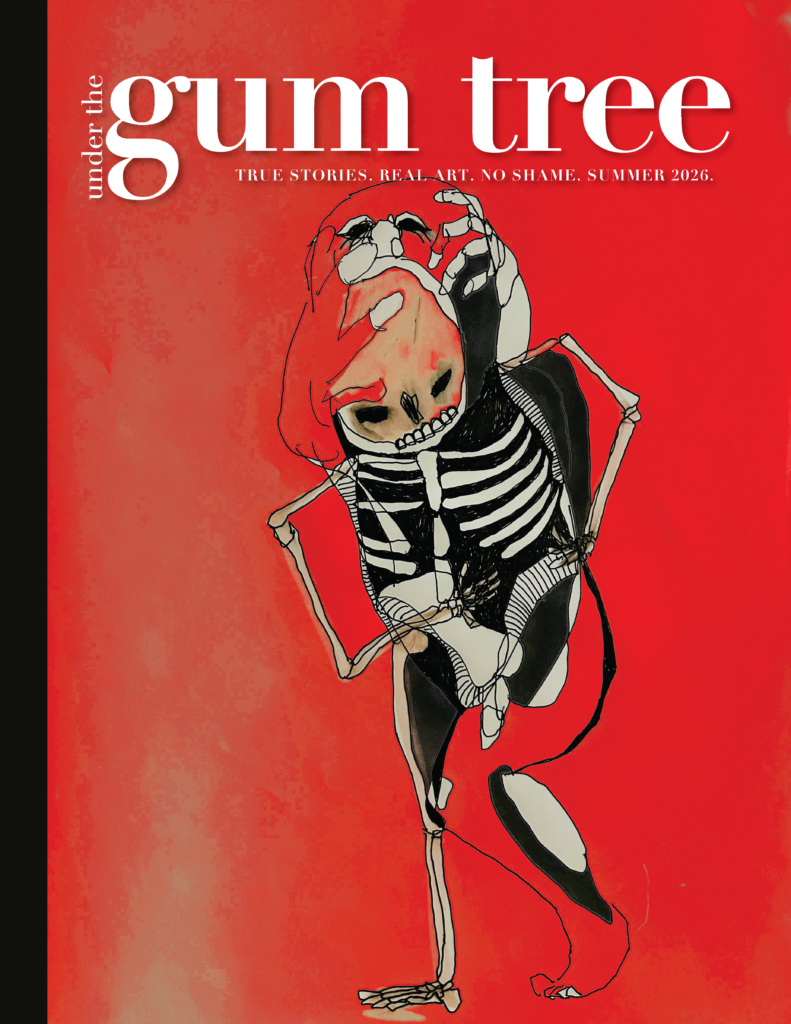
What’s inside the issue?
Click the links for a teaser excerpt of each piece…
Letter from the Editor
Recently I read the book Dopamine Nation by Anna Lembke, MD. I was surprised to arrive at chapter eight, the second to last chapter, titled “Radical Honesty.” Here was a book primarily about addiction—not just to substances, but to any behavior that causes dopamine overconsumption in the brain—focusing an entire chapter on the healing effects of truthtelling.
Lembke uses the myth of Odysseus as an example of what she calls “self-binding” as a strategy for eliminating addiction triggers. The story of Odysseus may or may not be relatable in our modern age, given that he literally binds himself to the mast of his ship to avoid being lured to his death by the Sirens. But Lembke returns to this myth in the “Radical Honesty” chapter, explaining that there is a little-known epilogue to the myth.
Why didn’t Odysseus simply plug his ears with beeswax as he commanded the rest of his crew to do?
“Odysseus wasn’t a glutton for punishment,” Lembke writes. “The Sirens could be killed only if whoever heard them could live to tell the story afterward. Odysseus vanquished the Sirens by narrating his neardeath voyage after the fact. The slaying was in the telling.”
The slaying was in the telling.
Later in the chapter Lembke writes about the importance of a truthful autobiography for healing, and for creating the life—the future— we want for ourselves.
This, my friend, is the heart of what we do here at Under the Gum Tree.
Someone also recently said to me that they have never understood the “without shame” component of our philosophy. They said it sets a negative tone. “Why presume shame?”
But that’s just it—we promote and amplify truth-telling as a path to healing. As a path to turning the hard bits of our experience into the things that shape us, that make us stronger, that empower us, and that allow us to grow into the person we are meant to be.
As we learn from Odysseus, the only way to vanquish shame is to tell the truth about what happened.
The slaying is in the telling.
As with every one of our issues, we again have several brave writers doing some slaying of their own in these pages. They tell their truth about wrestling with faith and spirituality when confronted by a dear friend, learning to accept their body, coming to terms with a hurtful family dynamic, contemplating taking their own life, and more.
And, as always, I hope these stories inspire you to tell your own stories without shame.

Janna Marlies Maron
Editor & Publisher
Contributing Authors
-
Deborah A. Lott
Deborah A. Lott
On Not Being SavedWendy and I sat at a round banquette in a nondescript hotel dining room designed to seat two hundred, but empty save for us and two men in white dress shirts many tables away. We’d picked a location just off the 405 in Orange County, halfway between where she stayed while in town, and westside LA where I lived. A few years ago, we might have ventured to South Coast Plaza to relive some of the shopping expeditions of our youth, but neither of us had the will or the stamina.
Since Wendy had moved out of California, we saw each other once a year, but with Covid, it had been several.
She looked older and frailer, though she still had the blonde bob with bangs she’d had since the day we met in fourth grade. She’d just come through a life-threatening illness, and I was relieved to see her enjoy a meal.
We finished our rice bowls, dishes cleared, check waiting, no dessert on the horizon. Wendy had shared the harrowing details of her surgery and recovery. We’d caught up on spouses, family members, reminisced about childhood. So much of our relationship hinged on those reminiscences. Still, we lingered at the table. Who knew when, or if, we’d see each other again?
Wendy started to cry. Her face collapsed before her words registered.
“I want you to be in heaven with me,” she said.
I took her hand, which felt cold and thin, and my own eyes filled. When Wendy cried, I cried. Wendy wanted to save me, again, just as she had when I was a lonely kid in elementary school and she became my first best friend.
Deborah A. Lott is the author of two books, In Session: The Bond between Women and Their Therapists, and the memoir, Don’t Go Crazy Without Me. Her creative nonfiction and reportage have been published in the Alaska Quarterly Review, Bellingham Review, Black Warrior Review, The Rumpus, Salon, HuffPo, Eckleburg, and other places. Her essays have been thrice named as Notables in Best American Essays. She teaches at Antioch University Los Angeles and serves as editor-in-chief of Two Hawks Quarterly.
-
Lori Rottenberg
Lori Rottenberg
Why I Stand on the Right in Every PictureIn 1975, I look straight at the camera for a school photo for the last time: asymmetrical and exuberant in a red turtleneck and ruffled corduroy jumper, still unconscious about the cleft lip scar, mine from infancy, my hair still silky and wavy, not yet kinked by puberty. I liked school, that place of safety. Its Roman pillars upheld my belief in a just universe and in my uniqueness.
In middle school, things would be different. The low-slung halls of concrete block would thrum with subterranean class warfare, jocks versus potheads. I did not play sports, but was a known exotic, suspect. I would get braces and operations, quixotic attempts at repair. A beautiful boy named Vaughn, destined for a coverall with his name embroidered in a blue oval, found me easy prey. His turquoise eyes held mine as I made up a test after school.
Lori Rottenberg is a writer whose forthcoming (2026) debut poetry collection, The Enchantress Queen and The Ghost Who Made Me, won the 2025 Changing Light Novel-in-Verse Prize from Livingston Press. Her work has appeared in many journals, anthologies, and podcasts. She served as a visiting poet in Arlington Public Schools for over a decade and received her MFA in Poetry from George Mason University, where she teaches English to international students and poetry to honors college students.
-
Barbara Ferraro
Barbara Ferraro
How to Cook Like an ItalianMan on top, woman in the kitchen—Italians love to dominate. Food was a religion in my husband Gar’s family, like the one they pretended to practice on Sundays. But this one was for real.
Gar’s family was everything my family was not. Big, loud, colorful, smoking like troopers, and talking with their hands and laughing and eating with abandon. Food was the epicenter of their lives, an expression of love, a big hug wrapped in marinara and tied with a Chianti bow. Simple food, well prepared, with utmost respect for the ingredients. Tomatoes, basil, garlic, pasta. They lived it, breathed it, savored it. What did I know? I came from a place of stringy pot roast and tuna noodle casseroles.
Affection, generosity, amore, all rolled into one. A little red sauce for the soul. When a regular American girl marries a nice Sicilian boy, as I did many years ago, she’d better learn how to cook.
Barbara Ferraro is a third-generation Chicagoan and recovering interior designer who has turned her creative energy from planning thoughtful rooms to penning her debut, Blue-Eyed Outlaw: My Search for the Truth in a Tight-Lipped Sicilian Family. Family, furniture, food, and the city that defines her form the love language that spills into her writing. You can find her words on the Brevity Blog and in the Chicago Tribune. barbarajferraro.com
-
Rob Rogers
Rob Rogers
The Poster in My ClosetIn a dusty guitar case in the corner of my closet, among boxes of thirty-year-old photographs, rests my most sacred possession. I first found it a quarter-century ago, in 1999, in an arts and crafts room while sifting through magazines with soft-tipped scissors, searching for clips for a collage during hospitalization for suicidal depression. Among wrinkled copies of Time Magazine and Vogue emerged an anniversary issue of Rolling Stone, and there, squeezed between pages 76 and 77, was the foldout black-and-white poster of Artist of the Decade, Kurt Cobain.
On that long ago afternoon, the expression on his face grabbed hold of me. Unusually well-shaven with combed but still unwashed shoulder-length hair, blonde like mine, Cobain was contemplative, not smiling but not pouting. Piercing eyes that stared out from a long-dead past, like La Gioconda, stole my breath. I turned to see if anyone had noticed my discovery, then fled to the corner of the room and began to weep, clutching the old poster to my chest. I had been living at the hospital for two weeks—it was not uncommon for patients to be overcome with emotion.
Kurt Cobain had been dead for five years, but his music was one of the few things keeping me alive, immunizing me to a world where I felt that I didn’t belong.
Now, more than twenty-five years later, the deafening roar of his guitar and the cathartic rasp of his yells continue to pulse through my veins.
Rob Rogers is a writer and attorney from Orlando, Florida. His first book, Finding My Way Home: Fighting Depression Backpacking in Central Florida, won the Bronze Medal for Autobiography/ Memoir at the 2025 FAPA President’s Book Awards. Rob’s essays have been published in Ponder Review, Four Tulips, and Still Point Arts Quarterly, and he also writes a blog called the Central Florida Backpacking Desk Jockey (backpackingdeskjockey.blog). Find more at robrogerswriter.com.
-
Emilie K. Adin
Emilie K. Adin
Smitten by the Cat's MeowMy compass once pointed to dogs, but it has spun out. I’m undone.
How does a lifelong dog person, middle-aged and set in her ways, fall in love with her cat? Can I even call myself a dog person anymore? This has amounted to no less than a watershed change to my self-identity.
The cat I fell for is not even a new cat. We’ve had her for twelve years. Nor is she the first cat I’ve lived with—the seventh. Nor again is she a cat we sought out as a pet. Not at all. She came into our lives as a ratscaring device. Years ago, I read of Kolkata’s Karni Mata Temple, where rats are considered sacred. Priest and congregant alike will pamper them, and their numbers have metastasized. The intersection outside the temple, said to be overrun with scrabbling businessmen and rats, has gently simmered in my imagination.
A decade ago, a park near my home hid a subterranean palace for vermin. A warren of tunnels and perhaps furnished suites formed a complex, interconnected community under the park’s entire city block. When bulldozers came to redevelop the park, the rats fled.
Emilie K. Adin is a city planner, writer and speaker, and an adjunct professor at Canada’s University of British Columbia. Emilie completed the University of King’s College MFA in Creative Nonfiction in 2025, a program that gently reminded her that writing can be playful, curious, and alive. Her writing appears in The Globe and Mail, McSweeney’s Internet Tendency, The Tyee and elsewhere. Find more at emiliekadin.com.
-
Sana Fayyaz
Sana Fayyaz
Diving in GriefA month after our firstborn died, Shakil and I were struggling to get into wet suits on the shores of Palm Jumeirah beach. The doctor suggested it would be good for us to move on. So, like typical South Asian expats living in Saudi Arabia, we vacationed to the glitzy artificial islands shaped like a palm tree to forget about our grief. Maybe the garish over-the-top glamor of Dubai would put a Band-Aid over our gashing wound.
Shakil fit into a medium, but my post-pregnancy body was unforgiving. I opted for a larger size hoping it would be a modest fit, but the garment clung to every curve, highlighting my deflated balloon of a belly. When I tucked my hair into my hijab, I shuddered at the contrast of my fitted wet suit and modestly covered head. Why was I doing this again? I didn’t know how to swim and never had any interest in scuba diving. Normally, I’d be scared of drowning, a shark attack, stinging of stingrays, inking of octopus, sticking of jellyfish, and pulmonary embolism. Since the passing of our daughter Mehak, death and other lesser inconveniences had lost their edge.
Sana Fayyaz is a Pakistani-American writer and mother of four based in New York. Shaped by life in Pakistan and Saudi Arabia, her work sits at the intersection of grief, faith, and immigrant identity. She writes about loss, resilience, and how love and sorrow are carried in the same breath. She is currently at work on a memoir, Fragrance of Grief. This is her first byline.
Contributing Artists
-
Eclosion, Joshua Hunt
Joshua Hunt
EclosionJoshua Hunt is a graphic artist and illustrator from Arizona whose work explores the deeply personal relationship between artist and image. He views painting and illustration as a process of discovery rather than creation, uncovering forms and ideas that already exist beneath the surface. For Hunt, each piece reveals a hidden part of himself, making both the artwork and the artist more fully realized through the act of creation. By sharing these images, he offers a glimpse into his inner world, using art as his most natural and authentic means of self-expression.
@jd.hunt
jdhuntart.com