
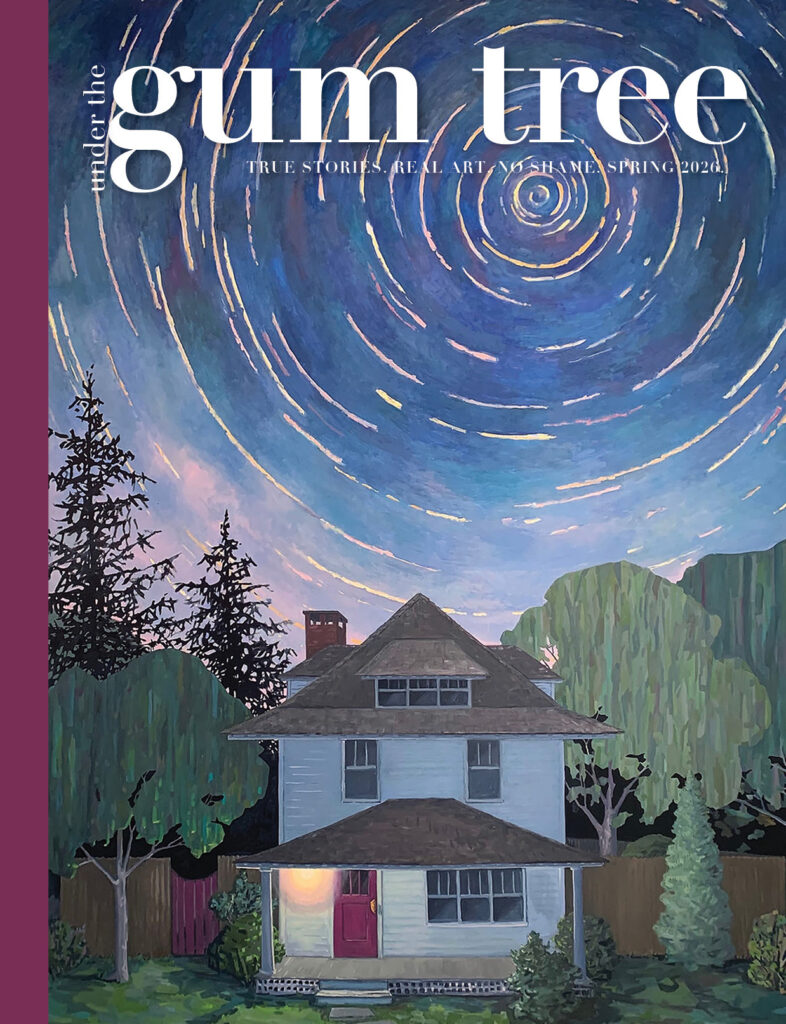
What’s inside the issue?
Click the links for a teaser excerpt of each piece…
Letter from the Editor
It’s March as I write this, and here in the west temperatures are already soaring. Much like 2025, the year thus far has proven tumultuous and, on several levels, terrifying. Catastrophic weather and unspeakable violence to name two—in the United States and around the world. A sign in my son’s front yard with the words “Let’s Make 1984 Fiction Again” encapsulates the fear, disbelief, and resolve many are experiencing. Actions and events that once seemed exclusive to the realm of apocalyptic fiction have become all too real.
Art has always allowed humans to give voice and expression to our lived experiences. In times like these, the creative impulse becomes an imperative. Now entering its fifteenth year, Under the Gum Tree is proud to continue sharing your true stories and visual art. We hope to continue this publishing journey for years to come, and to evolve and grow along the way. I have served as the magazine’s managing editor for five years. Reading hundreds of true stories and collaborating with a small but mighty team to produce a beautiful and tangible artifact every three months is an honor and a pleasure. The issue you hold in your hands is the work of an all-volunteer staff—guided by the vision, leadership, expertise, and commitment of editor and publisher Janna Marlies Maron.
Art director and designer Evan White has been selecting Under the Gum Tree’s visual art and photography for ten years. He is also responsible for the magazine’s distinctive and award-winning design and layout. In 2025 we were proud to make Sub Club’s Best Lit Mags list for Beautiful Design! And, over the years, Best American Essays has recognized a number of our published essays as notable—this past year was no exception, with recognition for Cecilia Villarruel’s “The Pianist” from the Fall 2024 issue.
I’m grateful for Janna, Evan, senior editor Cat Hubka, and our current fantastic cast of assistant editors—Sara, Debra, Holly, Will, and Cynthia!
Continuing our tradition, this issue contains six true stories. The perfect bliss of a clementine, parenthood’s challenges and rewards, first love, and the abiding mystery of memory, plus the gorgeous art of KK Kozik. Here’s to art in all its guises and to telling true stories without shame, now and always.
Dorothy Rowena Rice
Managing Editor
Contributing Authors
-
Nicholas Dighiera
Nicholas Dighiera
Seattle, WashingtonI close my eyes, take a breath, and roll out from under the van, having just swapped the radiator.
“Alright, should be fixed,” I say to Dominic, my eight-year-old son. He’s squatting in the gravel, flicking pebbles with a stick. “Let’s fill it up with coolant. Can you jump in the driver’s seat?”
He climbs in. I walk over to him. He is already fiddling with all the switches and buttons, flipping the blinker and wiggling the gear lever. I place my hands over his to calm them.
“Dude, can you do this?”
“Yep.”
“No buttons, no switches, right?”
“Yessir.” He is bouncing in the seat.
“Okay, I need you to turn it over when I say, then turn it off when I say stop.” I show him how that works. He nods. I ask if he understands. He nods again. I ask him to repeat it. He does, in a way that makes me believe.
I go to the engine and start filling and he watches me. It’s over ninety degrees; he is in the shade, but I am standing in the sun and the sweat between my legs is visible on my pants. I upend a gallon of coolant into the opening, squeezing and flexing all the hoses. I have him turn the engine over and it fires right up. We cycle again and bleed out the air.
Nicholas Dighiera strives to put love into the world with writing. He’s had work published in River Teeth, Hobart, Catamaran Literary Reader, Fugue, the Forge, and others. He’d like to grab a beer with you sometime and smash his heart together with yours so that, for a brief instant, you both will feel less alone in this terribly beautiful existence. Find more at nicholasdighiera.com
-
Lucy E.M. Black
Lucy E.M. Black
The Sam McBrideOn summer nights we would take the subway to Union Station and walk south under the Gardiner to the ferry terminal. Then we would ride the Sam McBride back and forth to the Island. We went alone. He said he wanted me all to himself. The crew knew us. They pretended not to notice that we stayed on board and took multiple crossings on one fare. Maybe they remembered what it was like to be seventeen. And we really weren’t any trouble—just two kids in love. For one evening a week, we were world travellers on the deck of a large ship taking us to exotic destinations. We’d lean over the railing, his arm heavy across my shoulder, and imagine we were cruising the Mediterranean or navigating the Nile. Every crossing took us to a different destination. We imagined exploring worlds we had only read about.
Lucy E.M. Black is the author of The Marzipan Fruit Basket, Eleanor Courtown, Stella’s Carpet, The Brickworks, Class Lessons: Stories of Vulnerable Youth and A Quilting of Scars. The Mural is forthcoming in the Spring of 2027. Her short stories have been published in Britain, Ireland, USA and Canada. She lives with her partner in the small lakeside town of Port Perry, Ontario.
-
Craig Reinbold
Craig Reinbold
All InI’m still a newbie, new to sport climbing, new to leading routes, and this one is at the outside edge of my ability. It’s short—thirty feet—but kicks off with an overhang that snubs many. I pass the overhang and clip safely into the first bolt. A few moves later I wedge my toes into a crack and am now maybe fifteen feet off the ground. I curl my fingers around a half-inch hold, chest-height, and extend my left hand to snap a quickdraw onto the second bolt.
Unbelievably, it is just out of reach.
Seems the crack I followed to get here was a bit to the right of the prescribed route. Rookie mistake. And there’s the bolt, just out of reach. Like, half an inch—so stretch a little, right? Not so simple. My left arm is free, but the rest of me . . . I can’t move an iota. My calves are already twitching, fingers weakening. Reach again. Gain a quarter of an inch. Still no dice.
Craig Reinbold is a writer whose work has appeared in The Sun, AGNI, River Teeth, and online at The Missouri Review, and his essay “What I Don’t Tell My Wife” was recently awarded a Pushcart Prize. He works as a nurse in the Emergency Department of a hospital in southeastern Wisconsin.
-
Hadley Duncan Howard
Communing with ClementinesI wasn’t just pregnant—I was pregnant and really, really bad at it. Into each life a little rain must fall, sure. Much of my life’s rain has had to do with making babies. At that point, I’d had three miscarriages—there’d be a couple more later on—and this pregnancy that seemed to be holding had been a particularly disgusting sort of drama from the get-go. My husband had become my custodial crew, following me around with a bucket and a damp rag. I was certain he was secretly wondering how he’d ever liked me well enough to get me pregnant in the first place. I’d never felt so profoundly mortal, so clearly made of dust.
We’d just arrived in Australia, my husband’s homeland. Miraculously arrived, more like. The gate agent in Los Angeles had taken one look at my pallid face, lifeless eyes, the whiteness of my lips, the roundness of my belly and had—all blessings on his coiffed and highlighted head—put his finger to his lips in a gesture of silence and kindly upgraded us to first class. We’d crossed the Pacific on sacred beds of solace, shrouded in feather duvets of glory.
Hadley Duncan Howard is a writer, editor, and creative. Her work often focuses on themes of identity, family, and faith, with essays published or forthcoming in Dialogue, Exponent II, and elsewhere. She’s a lover of life’s little beauties and quiet comforts, starting with dogs and Diet Coke. Find her online: @notingthebeauty.
-
Kase Johnstun
Kase Johnstun
Can't Hardly WaitWe yelled out to Angela. To be more accurate, my lifelong friend, Heather, yelled “Angela!” to a group of runners who huddled near a car in the middle of a dusty, dirt-covered parking lot during a thirty-six-hour Ragnar running relay in early June.
Red earth caked our shoes and teeth, filling in the crevices of enamel and wicking fabric.
“Angela!” Heather yelled it again.
We hoped this blonde woman with long, thin, tan, athletic legs would turn around. We hoped that maybe the woman would yell back, “Heather,” or “Kase,” or “Heather and Kase!” We hoped that maybe this woman we hadn’t seen in twenty years would actually be Angela. The blonde woman didn’t respond. She walked away. But Heather had hope. Heather always has hope.
“She turned her head,” Heather said. “I swear. She turned her head. I know it’s her.”
“I think she did too,” I said. I did think that, though I also thought I could have imagined it.
Twenty years earlier Angela disappeared from our lives after a one-year visit. Why did we care? Partly because it’s what Heather and I do—when we’re together, we chronicle our lives as friends.
Kase Johnstun is the Director for the Utah Center for the Book at Utah Humanities. He is the author of two award-winning novels, Cast Away (Torrey House Press, 2024) and Let the Wild Grasses Grow (Torrey House Press, 2021), and he is the author of the award-winning medical memoir Beyond the Grip of Craniosynostosis (McFarland, 2015).
-
Raven S.C. Lee
Raven S.C. Lee
Motherless on Mother's DayIt’s another parenting drop-off. This time, I am driving my daughter, Sage, to Bozeman from Portland for their summer job with the Montana Conservation Corps. We started that morning in Coeur d’Alene, Idaho, where Sage climbed barefoot over a fence to gather dogwood flowers in the courtyard of the Holiday Inn Express. Sage showed up at the breakfast table with a paper cup from the buffet full of dogwood blooms and a Happy Mother’s Day card. Surrounded by other travelers, we shared breakfast in the sunny courtyard before getting back on the road.
Mother’s Day generates complex feelings for me. My mother has chosen not to be in my life since I was five. When my kids were small (they are now both in their early twenties), Mother’s Day unearthed feelings of grief and loss. But then, right in front of me, were these two beautiful souls. My husband would shepherd them through the day, trying to get them to behave in restaurants, keeping them busy making something or cleaning something. They were mildly reluctant, distracted and unconcerned with my feelings. I tried not to take their indifference personally. Containing my feelings about my own motherlessness was emotional gymnastics.
Driving to Bozeman with my youngest is an antidote to the typical Mother’s Day Blues and the internal struggle to protect others from my loss.
Raven SC Lee lives on unceded land of the Confederated Tribes of the Grand Ronde and Siletz Indians on Wy-East (Mt Hood, Oregon) where she spends her time writing, hanging out in the forest and throwing funky pots. Raven writes memoir, essays and poetry. Her writing has appeared in Eunoia Review, One Art, Amethyst Review, Honeyguide Literary and Hip Mama. Raven is on a hiatus from her career as a psychologist and therapist trainer.
Contributing Artists
-
Long Night, K.K. Kozik
K.K. Kozik
Long NightKK Kozik is an American painter whose work explores landscape, memory, and the quiet persistence of place. Influenced by early American writers such as Nathaniel Hawthorne, Herman Melville, Ralph Waldo Emerson, and Henry David Thoreau, Kozik approaches landscape as both a physical environment and a space charged with atmosphere and meaning. Her large-scale paintings are created through movement and intuition, emphasizing direct mark-making and an immersive, physical relationship with paint. Kozik’s pared-back compositions reflect the stark clarity of winter landscapes, using place and season as analogs for life’s cycles of change and quiet endurance.
@kk2kozik
k2kozik.com