
What’s inside the issue?
Click the links for a teaser excerpt of each piece…
Letter from the Editor
Every fall we celebrate the anniversary of Under the Gum Tree. This issue marks fourteen years of publishing—fourteen!
As I sat down to write this editor’s letter I was having a hard time, because I don’t think I can sufficiently put into words the feelings that come up for me when I think about how long I’ve been publishing this magazine. It’s pride, for sure, but also amazement, a little bit of disbelief, and sheer appreciation and gratitude.
I have so much gratitude for the people who volunteer their time to consistently make publishing this magazine possible, and for the writers and artists who continue to send us their work.
But more than that, I am deeply grateful that there are writers and artists who, first, make time for their creative work, and, second, send it out to be considered for publication.
It’s a practice of persistence and trust.
Persistence to keep going, even when it seems impossible—and after publishing this magazine for fourteen years, I can confidently say I know a little bit about that.
But trust is required to fuel that persistence.
And if there’s one thing I can impart to you after the years I’ve spent reading the hundreds of stories we have published in these pages, it’s this:
If you’re a writer (or artist), the most vital thing you can do for yourself and your creative work is to cultivate trust in yourself— in your own voice, your story, and your work.
Trust that you have been given your story for a reason—that the Universe has entrusted you with the life and experience you’ve had, and if you have a desire to write about it, that’s all you need.
Your perspective, your thoughts, your feelings, your voice, your lived experience— no one else has it. No one else can fabricate it. It’s yours alone. And, it’s enough.
Your story is enough. Your voice is enough. You are enough.
On this, our fourteen-year anniversary, I’m profoundly grateful to the writers in these pages. They trusted themselves, and their story, enough to send us their work so that we can now share it with you. When you read this issue’s themes of longing, desire, belonging, anger, tension, and identity, I hope you experience the many emotions that good stories are meant to evoke. And, I hope you feel the sheer gratitude I do every time I flip through these pages.
Here’s to another year of telling stories without shame,

Janna Marlies Maron
Editor & Publisher
Contributing Authors
-
Melissa Fraterrigo
Melissa Fraterrigo
Coach MattOn the first day of the summer 1987 swim season, a college-aged guy in flip flops with electric blue eyes stood beside Mrs. Renolds, the team president. Our regular coach, who taught at the high school, was nowhere to be seen. Mrs. Renolds introduced Matt, a student from the University of Kentucky, as our coach. This new coach had blond hair and wore a U2 T-shirt.
It felt odd from the start.
“This is Coach Bedar,” she said. “He’s home for the summer from college and we’re so happy to have him here.” Mrs. Renolds looked his way and giggled, her stomach jostling in ropy swells she failed to notice.
“Coach Matt is fine,” he said and gave us a little wave.
Mrs. Renolds told us to have a good practice and left the pool deck, steel door clanging shut. During the school year there were anywhere from thirty to forty kids on the team. Attendance dwindled in the summer. Now I was one of ten kids standing around the Thorton Fractional South High School pool and the oldest there. I’d just finished the eighth grade and would be starting high school in the fall.
I stood there and shivered in my suit. I was nearly naked, but my bareness hadn’t registered until now.
Melissa Fraterrigo is a writer whose memoir, The Perils of Girlhood, was published by the University of Nebraska Press in September 2025. She is also the author of the novel Glory Days (University of Nebraska Press), and the story collection The Longest Pregnancy (Livingston Press). She teaches creative writing at Purdue University, in the Butler University MFA in Creative Writing program, and is the founder of the Lafayette Writers’ Studio in Lafayette, Indiana. Find more at melissafraterrigo.com.
-
Claire Hanlon
Claire Hanlon
For Now We See Through a Glass, DarklyCrouching under a tree, we select two rocks with which to crack the nut. The bottom rock—largish, flattish—is a sturdy anvil on the sandy ground. The other rock, fist-sized, is for pounding. The nut is an elongated egg, dark brown and glossy. My friend has acquired a handful—from where, I do not ask.
I am not a native of this village. I do not question why she wants to share with me, because the people here are generous and are always offering things to me, the outsider. My pale skin and straight hair signal my otherness, the necessity for generosity and preferential treatment, which makes me uncomfortable— all of it lives in a little knot in my belly. That and my natural shyness usually prevent me from confidently mingling with other kids, so I am happy to be accepted this afternoon.
My friend shows me how to place the nut in a hollow on the flat rock, how to smash it open with the pounding rock, probably a white-bleached chunk of coral. Most of this village is coral, or sand which was once coral.
Smash. The brown skin tears, revealing a surprising green pulp that protects a hard inner shell. Pound, pound, crack. She pulls apart the busted shell and inside is a translucent white nut. My friend calls it a ngali nut. Fresh from the shell, it looks tender as a larva, pinkish segments folded up on each other in whorls and furrows. My friend offers it to me, and I take a nibble. Soft but crisp, it has a sharp, sweet flavor. It tastes alive.
Claire Hanlon spent her formative years moving frequently between the various islands and nations of Oceania. She’s also lived in California, Montana, and now Texas, where she shares a home with her husband, son, three cats, and a dog. Her most recent work can be found at HAD and X-R-A-Y, and she has essays forthcoming in several publications, including Passages North, and Image Journal. Find her at clairehanlon.com or on Instagram as @loveyclairey.
-
Justin Kolber
Justin Kolber
The Pretzel ProblemIt was 10:30 a.m. on a weekday in October, my perfect moment. I had pinpointed a low-traffic time to avoid people—a paradoxical challenge, since I lived in New York City. I needed to buy something rare, something genetically engineered just for me—usually found in a shopping mall. Handheld, spongy and syrupy, with maximum mouth-feel—an Auntie Anne’s pretzel. Or more specifically, twelve Auntie Anne’s pretzels.
Walking through the Penn Station food court, I was hungry and on a stealth mission. How loud is Penn Station during a weekday mid-morning? To me, it’s dead silent. I turned up my headphones to help me dissolve into the crowd of commuters. Listening to Radiohead’s “How to Disappear Completely (And Never Be Found)”—yeah, I know, I’m a cliché. But maybe things are clichés for a reason—there’s universal truth in what we do compulsively. I needed Thom Yorke’s sprawling chimes to distract me from my growling stomach and my other tape player, the one telling me I am skinny and fat and disgusting and ugly and . . . weak.
Justin Kolber is a practicing lawyer in Vermont, a recovered ripped dude, an athlete, activist, and author of Ripped, the first memoir about the dual extremes of muscle and food disorders. Read more at Slate, Newsweek, The Good Men Project, Open Secrets, The Greener Pastures and in Justin’s free newsletter at justinkolber.substack.com.
-
Eric Mueller
Eric Mueller
A Captain's PracticeThe perfect date for me would not include movies, dinner, or even April 25. For years, all I’ve wanted is to spend a late morning with a guy and do football drills together in an open field. I floated the idea with a few different guys—I always get a look that makes me feel like I have three noses or too many buttholes.
Years of great love have led to more than enough dates, life-changing thrills, and adventures with special men. But because I spent almost a third of my life up to this point playing the game, consumed by it, I want the man I love (or one I want to love) to get where I’m coming from, to feel it in their body. We’d go to a field, one with lots of grass and few or no onlookers. We won’t be doing anything salacious, but we deserve our own peace, separate from the outside world that kept us apart for longer than it should have. We won’t do much in terms of collisions, just the offensive and defensive line drills I did day after day for year upon year.
I don’t want to get all dressed up in full foosball fantasy regalia—we won’t need all that gear. It’d be more like a captain’s practice—one in gym clothes and devoid of coaches, mostly meant to bring the team closer together. So long as we warm up properly, we shouldn’t get hurt, especially not our heads. We’d wear shorts (preferably gray), tank tops (or crop tops if anyone’s feeling their oats that day), compression shorts that peak out the legs of our gym shorts even when standing up straight (because jock straps can get uncomfortable, tangling with thighs, hair, and nuts), and cleats as opposed to tennis shoes, so neither of us falls. Sweat stains resembling Rorschach tests would start forming on our backs before the first drill.
Eric P. Mueller lives in Oakland, California. He holds degrees from Allegheny College and the University of San Francisco. His essays and reviews have appeared in Foglifter, 14 Hills, The Ana, Vagabond City Review, BULL, and elsewhere. Eric likes his wine red, his coffee iced, and he will never turn down an invite to emo night or karaoke.
-
Anne Sawyier
Anne Sawyier
On Writing a Love Letter During a JailbreakI need to leave LA. The cliché I’ve become sticks its grotesque tongue out and mocks me—a Midwesterner moving out west to be amongst the bright stars, only to find that the brightest stars are back home. The stubbornly unchanging fact of my dad’s death has made a fool of California’s promise of “fresh starts.” Without the promise of a life glittered with Hollywood lights, this city-that-is a-suburb has morphed from familiar friend to prison, trapping me in its relentless sprawl.
I have refused new friends in this city that’s already in my rearview mirror—in this desert, I choke on the dust that is “getting to know someone.”
In my self-imposed exile, I kept thinking about Johnie’s Coffee Shop (yes, one “n”) at Wilshire and Fairfax, a now derelict diner about two miles from my West Hollywood apartment. Apart from the fact that it was blissfully undemanding in our interactions, I couldn’t figure out why this abandoned building, one I now only idle beside—stuck at the obstinate red light at the intersection— made more noise in my head than the car horns outside my window. Laid off from my job, in between trips to get myself out of LA, and having fed my cats their mid-morning treat, I finally relented to Johnie’s siren call.
Anne Sawyier is a New York-based writer currently pursuing her MFA in Creative Nonfiction at Columbia University. Her writing has appeared in the Los Angeles Review of Books, Another Chicago Magazine, DePaul’s Slag Glass City, and Half and One. Originally from Chicago, she earned her AB in Art History and Arabic from Harvard (2012), a master’s degree in art history from Oxford (2013), and an MFA in producing from the American Film Institute (2015). She is a devoted cat mother to Walter and Temmy.
-
Haley M. Forté
Haley M. Forté
A Symphony of ThreeDa Capo: From the beginning
I learn to rely on music at a young age.
The melodies and harmonies that flow through my headphones are not mere entertainment. They are an escape from the cacophony that blares through my home when the conductor raises his baton, gestures to the strings, and begins the next phrase.
The evening starts like any other—four smiling faces sitting around a cherry wood dinner table, food steaming on plates much too nice for a Wednesday night dinner. The conversation is light—it has to be. The conductor sits at the head of the table. It’s his spot. The first chair cello sits to his right, her gold wedding ring glittering in the low light of the hanging sconce above. The quiet viola sits next to me as she picks at her dinner, her nimble fingers already shaking. And I, the violin, try to keep it together though the food before me is no longer savory but sour.
I don’t want to eat.
I want this concert to be over.
The conductor notices I won’t eat. He doesn’t notice I don’t like the food. He doesn’t care.
He raises his baton.
Haley M. Forté is a writer—originally from Southern California, she currently lives in County Tipperary, Ireland, with her family. She earned an MFA in Creative Writing from Southern New Hampshire University. Her work has appeared in Bright Flash Literary Review and The Penmen Review. When she isn’t writing, Haley can be found learning all she can about the cosmos and spending time with her cat, Gracie. Find more at: haleymforte.com.
Contributing Artists
-
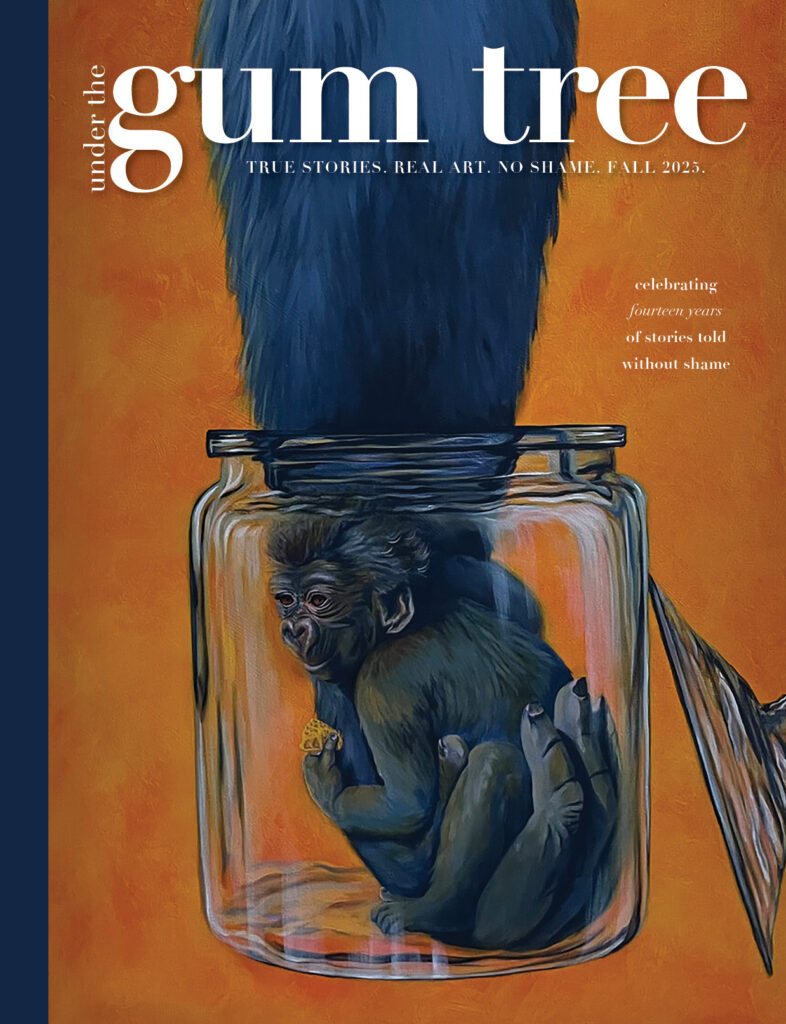
Stolen Moment, Elise Acosta
Elise Acosta
Stolen MomentElise Acosta is a painter whose work reflects the inner world of imagination, emotion, and identity. An introvert and autistic artist, she finds paint to be the most authentic form of communication, transforming personal experiences into visual stories. Her collections trace a journey from early motherhood to becoming an empty nester, through the pandemic, and into her life navigating autism. Blending humor with heavy emotion, she explores themes of belonging, isolation, and resilience. Through expressive canvases, Elise invites viewers to step into her perspective, finding connection and shared humanity in moments of vulnerability and joy.
eliseacosta.com
@artbyeliseacosta